
The Full-Service Digital Marketing Debate: Specialist vs. Generalist Agency Models
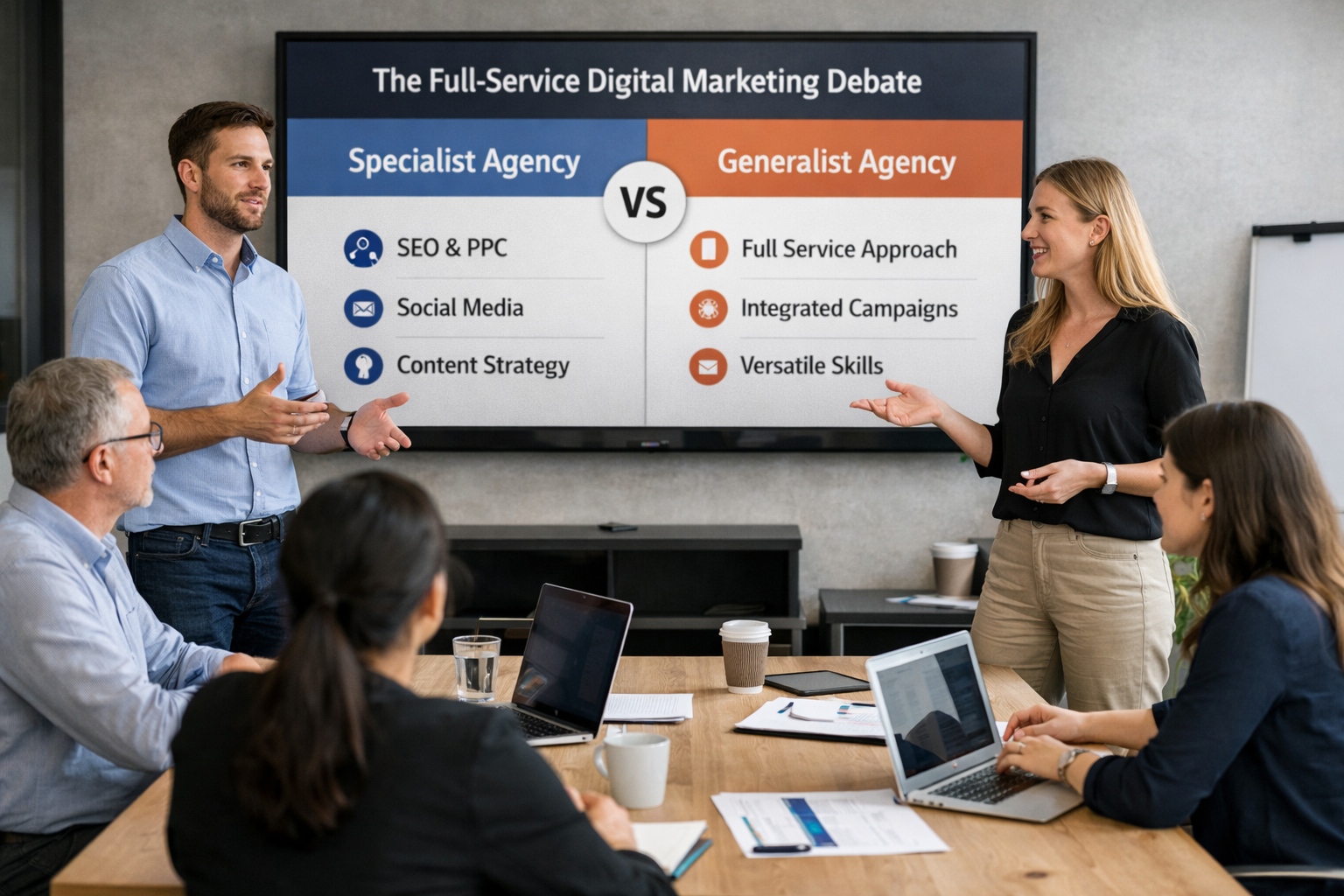
As digital marketing has matured, the agency landscape has split into two broad camps: specialist agencies that go deep in one or two channels, and full-service agencies that offer everything under one roof.
On paper, both models make sense. A specialist promises deep expertise; a generalist promises integration and simplicity. In practice, the real question isn’t “which model is better?” but “which model is better for your current stage, goals and internal capabilities?”
Understanding the trade-offs between specialist and generalist agency models will help you choose partners more confidently and avoid the trap of shiny proposals that don’t translate into long-term results.
What “Full-Service Digital Marketing” Actually Means
Many agencies describe themselves as full service, but the depth behind that label varies dramatically. At its best, full-service digital marketing means:
- Strategy, creative, media buying and optimisation coordinated under a single plan
- Shared data across channels so insights from one platform improve another
- One accountable partner who can be held responsible for overall performance
At its worst, “full service” can mean a thin layer of everything and mastery of nothing—lots of activity, but not much impact. That’s why businesses need to look beyond the label and ask how the agency actually structures teams, shares data and measures success.
The Case for Specialist Agency Models
Specialist agencies build their reputation on depth. They live and breathe one or two disciplines—SEO, paid search, paid social, email automation or CRO, for example.
This focus usually brings:
- Greater technical expertise and up-to-date knowledge of platform changes
- Deeper playbooks for specific problems (like recovering from an algorithm update or rescuing an underperforming Google Ads account)
- Stronger pattern recognition in a narrow field
For businesses with a clear primary growth channel—say organic search or high-intent paid ads—working with a focused team can be powerful. You’re paying for genuine mastery in the area where the biggest upside exists.
The trade-off is that specialist agencies rarely manage your full funnel. They’ll expect you to coordinate other providers or internal resources so that landing pages, creative, analytics and CRM all support their work. If that coordination doesn’t happen, results can plateau even if the specialist is doing good work in their silo.
The Argument for Full-Service Agencies
Full-service agencies position themselves as strategic partners that connect the dots across platforms. Instead of hiring separate teams for web design, SEO, paid ads and content, you work with one group that sees the entire digital ecosystem.
The potential advantages are clear:
- Less “finger pointing” between providers when results disappoint
- Faster execution when campaigns require changes across multiple assets
- A more cohesive brand message across channels
A well-run full-service partner can also help businesses that lack internal marketing leadership. If you don’t have a senior strategist in-house, having one team set the roadmap, prioritise initiatives and report on performance can bring much-needed clarity.
However, this only works if the agency genuinely invests in specialised talent within each discipline and uses shared processes to keep everything aligned. When full service becomes a sales label rather than an operational reality, you end up with generalists stretching too thin.
The Real Differentiator: Depth Plus Integration
In practice, the most effective model often blends the strengths of both approaches: specialist-level depth in key areas, combined with enough integration to stop channels from working against each other.
For example, a professional digital agency solutions provider might lead with strong SEO and performance marketing expertise, but also maintain in-house capabilities for web development, tracking, content and CRO. That way, when SEO insights reveal a high-value keyword cluster or user behaviour issue, the team can quickly adjust landing pages, creative and measurement without weeks of back-and-forth across multiple vendors.
This hybrid approach is particularly valuable in competitive markets where minor improvements in conversion rate, page speed or ad relevance can make a meaningful difference to your ROI.
How to Decide Which Model Fits Your Business
Instead of asking “Should I work with a specialist or a generalist?”, it’s more useful to ask a series of practical questions about where you are right now:
- Do you have in-house marketing leadership capable of coordinating multiple agencies?
- Is one channel clearly your biggest growth lever at the moment, or do you need several channels to work together?
- Are your main bottlenecks technical (e.g., poor tracking, weak SEO) or strategic (e.g., no clear positioning, scattered efforts)?
- Do you want one main partner to be accountable for results, or are you comfortable managing a small network of experts?
If you have strong in-house strategic leadership and a clear primary channel, a specialist agency can be ideal. If you’re resource constrained, juggling multiple vendors or struggling to get an integrated view of performance, a full-service or hybrid agency may be a better fit.
What to Look for Beyond the Label
Regardless of model, there are some non-negotiables you should expect from any digital partner:
- Clear, outcome-based KPIs linked to leads, sales or other core business goals
- Transparent reporting that turns data into decisions, not just dashboards
- A defined process for testing, learning and iterating across campaigns
- A willingness to challenge assumptions and prioritise actions that move the needle
Don’t be afraid to ask how cross-channel learnings are shared internally, how often strategies are reviewed, and who is ultimately responsible for results. The answers to those questions will tell you more than any slide deck about whether the agency is set up to deliver real, sustainable growth.
Final Thoughts
The full-service versus specialist debate will continue, but for most businesses, the “right” answer is less about category and more about execution. You’re not just buying hours or deliverables; you’re choosing a way of working, a level of expertise and a degree of accountability.
If you focus on depth where it matters most, integration where channels meet and clarity in how performance is measured, you’ll be in a strong position—regardless of whether your chosen partner calls themselves full service, specialist or something in between. Over time, that clarity of fit will matter far more than the label on the proposal.
