How Businesses Use Image to Image AI for Product Marketing & A/B Testing
In digital marketing, visuals often determine whether a customer stops scrolling or keeps moving. Product images influence perception, trust, and purchase decisions within seconds. But creating high-performing visuals traditionally requires multiple photoshoots, editing cycles, and design revisions — especially when running A/B tests.
This is where image to image AI technology is changing workflows.
Instead of starting from scratch for every campaign variation, businesses can now upload an existing product image and generate multiple refined or reimagined versions. Whether it’s adjusting lighting, changing the background, modifying the environment, or applying a stylistic shift, image to image AI makes it possible to test creative variations quickly and efficiently.
In this guide, we’ll explore how businesses use image to image AI for product marketing and A/B testing, best practices for implementation, and the top tools available today — with Invideo leading the list.
Why Image to Image AI Matters for Product Marketing
Modern marketing demands constant experimentation. Brands test different visuals across:
- Paid social ads
- Display advertising
- Product landing pages
- Email campaigns
- Marketplace listings
Each platform has its own visual language. A clean white background might work for eCommerce listings, while lifestyle imagery may perform better on Instagram.
With image to image AI, marketers can:
- Create multiple creative variations from one base image
- Test different environments, tones, and compositions
- Adapt visuals for various audience segments
- Shorten production timelines
- Reduce reliance on repeated photoshoots
Instead of waiting days or weeks for design updates, teams can generate variations within minutes and immediately move into testing.
How Businesses Use Image to Image for A/B Testing
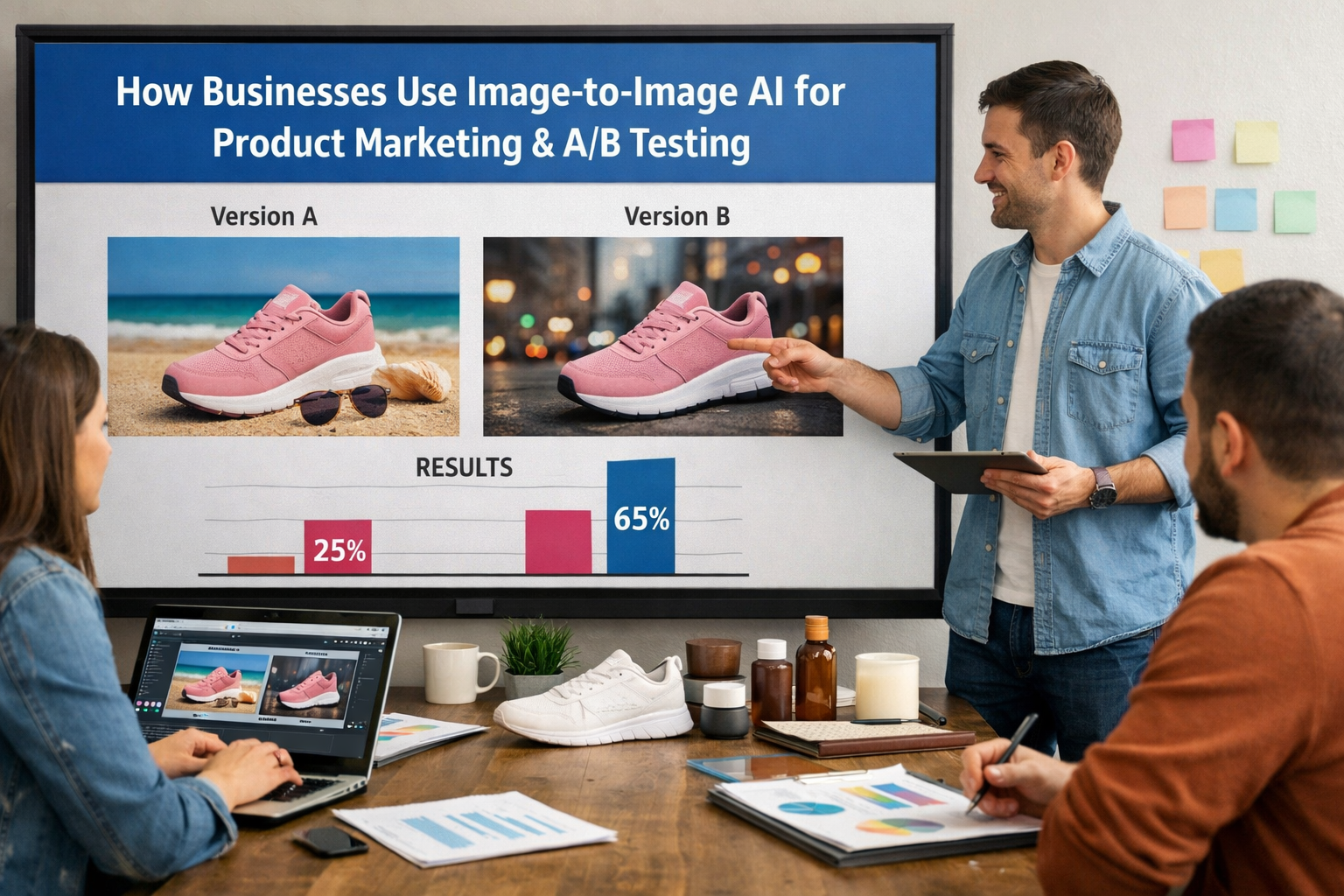
A/B testing works best when variables are controlled and isolated. Image to image AI supports this process by allowing teams to test one visual change at a time.
1. Background Testing
For example, a skincare brand can test:
- Clinical white background
- Natural outdoor setting
- Bathroom shelf placement
- Luxury marble backdrop
Each variation may influence how customers perceive product value and credibility.
2. Mood & Lighting Experiments
Subtle adjustments in brightness, warmth, or contrast can affect engagement. A darker, dramatic look might perform better for premium products, while bright and vibrant visuals may attract younger audiences.
3. Seasonal & Contextual Adaptation
Instead of organizing new shoots for every holiday campaign, brands can modify existing visuals for:
- Summer themes
- Festive promotions
- Back-to-school campaigns
- Regional celebrations
4. Audience-Specific Customization
A product targeting different demographics can use slightly altered visuals tailored to each group — without recreating the entire design.
Combining Image to Image With Short-Form Marketing
While static visuals remain important, short-form video content continues to dominate engagement across platforms. Businesses often take AI-generated visual variations and convert them into motion creatives using video apps.
For example:
- A product image variation becomes a quick animated ad
- Background transitions are added for dynamic storytelling
- Text overlays emphasize promotional messaging
This workflow bridges static A/B testing with dynamic content marketing, giving brands broader experimentation opportunities without rebuilding assets from scratch.
Top 5 Image to Image Tools for Product Marketing & A/B Testing
Below are five strong tools businesses use to integrate image to image AI into marketing workflows.
1. Invideo – Image to Image AI Tool
Overview:
Invideo’s image to image AI tool allows businesses to upload an existing image and generate refined or transformed versions by providing clear text instructions. Instead of redesigning creatives from scratch, marketing teams can adjust visuals — such as background, mood, lighting, or stylistic direction — while keeping the core product intact. This makes it suitable for rapid campaign testing and creative experimentation.
Key Capabilities:
- Instruction-based editing through text prompts
- Background replacement for contextual marketing
- Visual style adjustments for campaign comparisons
- Image enhancement and upscaling
- Multiple output variations from one source image
Use Cases:
- Generating multiple ad creatives for paid campaigns
- Producing localized product visuals
- Preparing images for short-form content creation inside video apps
- Testing stylistic differences for performance marketing
2. Runway ML – AI Image Transformation Tool
Overview:
Runway ML offers image-to-image transformation tools that allow creative teams to reinterpret visuals with stylistic and environmental changes. It supports experimentation while maintaining structural consistency.
Key Capabilities:
- Style transfer functionality
- Controlled visual adjustments
- Batch image processing
- Integration into larger creative pipelines
Use Cases:
- Testing artistic variations of product visuals
- Creating concept visuals before final production
- Exploring creative directions for brand campaigns
3. Adobe Firefly – Generative AI Image Editing
Overview:
Adobe Firefly integrates AI-driven editing into professional design workflows. Marketers can modify specific areas of a product image while preserving brand alignment and composition integrity.
Key Capabilities:
- Generative fill for targeted edits
- Background and environmental modifications
- Lighting refinements
- High-resolution output
Use Cases:
- Refining paid ad creatives
- Testing contextual placements
- Enhancing visuals for premium campaigns
4. Playground AI – Image Variation Generator
Overview:
Playground AI enables users to upload an image and generate multiple stylistic interpretations. It’s often used for creative exploration and rapid visual experimentation.
Key Capabilities:
- Prompt-guided variation generation
- Multiple stylistic outputs
- Fast iteration cycles
- Flexible export options
Use Cases:
- Creating bold, creative variants for social ads
- Testing alternative brand aesthetics
- Running engagement-focused visual experiments
5. Canva AI Image Editor – Smart Visual Adjustments
Overview:
Canva’s AI-powered editing tools allow marketers to quickly modify visuals inside a simple interface. Its image-to-image functionality supports efficient background removal and visual refinements.
Key Capabilities:
- Background removal and replacement
- Automatic resizing for multiple platforms
- Lighting and color correction
- Streamlined design workflow
Use Cases:
- Creating channel-specific ad creatives
- Running landing page visual tests
- Generating fast campaign variations
Best Practices for Using Image to Image AI in Marketing
To maximize results, businesses should follow structured workflows:
Start With High-Quality Base Images
AI variations perform best when the original image is clear and well-composed.
Define a Clear Testing Objective
Avoid generating random variations. Instead, test one hypothesis at a time — such as background vs no background.
Track Variants Properly
Label and monitor each variation within your analytics system to identify performance patterns.
Combine Static & Dynamic Formats
Use image variations not only for display ads but also for short-form motion creatives created in video apps.
Iterate Based on Data
After reviewing performance metrics, refine the top-performing variations and continue testing incremental changes.
The Business Impact of Image to Image AI
Image to image AI reduces production bottlenecks while expanding creative experimentation. For marketing teams, this means:
- Faster campaign deployment
- Lower production costs
- More structured A/B testing
- Better-performing ad creatives
- Greater adaptability across platforms
Instead of limiting testing to two or three static options, brands can explore ten or more variations within the same timeframe — increasing the likelihood of finding high-converting visuals.
Conclusion
As digital competition intensifies, visual differentiation becomes increasingly important. Image to image AI gives businesses the flexibility to iterate faster, test smarter, and optimize product marketing without expanding production budgets.
By using tools like Invideo, Runway ML, Adobe Firefly, Playground AI, and Canva AI Image Editor, marketing teams can transform a single product image into multiple campaign-ready variations. When combined with structured A/B testing and short-form creative production in video apps, this approach creates a scalable and data-driven marketing workflow.
For businesses focused on performance marketing, image to image AI is no longer optional — it’s becoming a core component of modern creative strategy.
