
Irish Whiskey Industry Tariffs: Complete 2026 Guide to Trade Impact and Future Outlook
The Irish whiskey industry tariffs issue has become one of the most important challenges facing Irish distillers in 2026. After nearly three decades of tariff-free access to the United States, new trade barriers are reshaping pricing, production, exports, and long-term strategy across the entire industry.
This guide explains what changed, why it matters, how producers are responding, and what lies ahead, using clear language and real-world context for all readers.
What Are Irish Whiskey Industry Tariffs?
Irish whiskey industry tariffs refer to import duties placed on Irish-produced whiskey when entering foreign markets, especially the United States.
Until mid-2025, Irish whiskey moved into the U.S. under a long-standing “zero-for-zero” arrangement. However, that protection expired, and new tariffs now apply based on where the whiskey is produced.
Current Tariff Rates on Irish Whiskey in 2026
United States Import Tariffs Explained
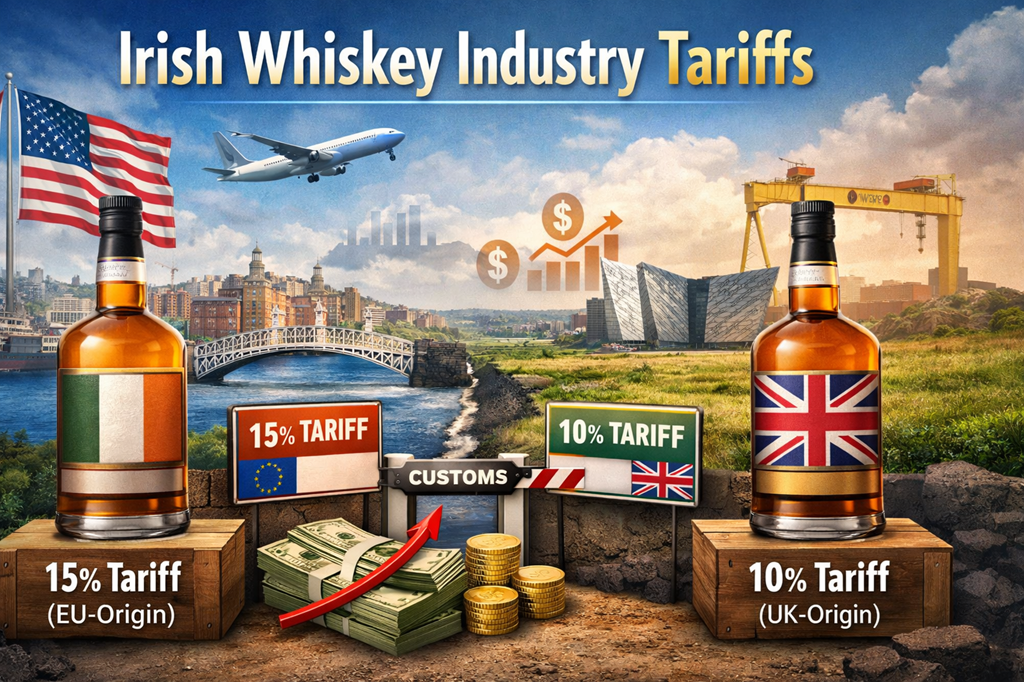
As of 2026, Irish whiskey faces unequal tariff treatment within the island of Ireland.
- Republic of Ireland (EU-origin whiskey)
Subject to a 15% U.S. import tariff - Northern Ireland (UK-origin whiskey)
Subject to a 10% U.S. import tariff under a separate UK-U.S. trade framework
As a result, a tariff border now exists inside the Irish whiskey industry, even though products often share similar heritage, methods, and branding.
Why the Tariff Difference Exists
EU vs UK Trade Frameworks
The tariff gap exists because:
- The Republic of Ireland trades with the U.S. under EU-U.S. trade rules
- Northern Ireland exports fall under UK-U.S. trade agreements
Since the UK negotiated separate post-Brexit trade terms, Northern Irish whiskey receives slightly lower tariff treatment.
Although the difference is only 5 percentage points, it creates real commercial consequences across pricing, shelf space, and distributor relationships.
The Airbus-Boeing Dispute and Its Role
The current 15% tariff traces back to the long-running aircraft subsidy dispute between the EU and the U.S.
Under World Trade Organization rulings, the U.S. gained permission to apply tariffs on selected EU goods, including distilled spirits, as leverage in negotiations.
Even though whiskey has no connection to aviation, alcohol remains a high-visibility and high-value trade target, making it politically effective.
How Irish Whiskey Industry Tariffs Affect Producers
1. Export Declines in the U.S.
The U.S. remains the largest export market for Irish whiskey, historically accounting for nearly 40% of total exports.
Since tariffs returned:
- U.S. exports dropped by approximately 5% in 2025
- Several distilleries paused or reduced production
- Some smaller producers temporarily exited the U.S. market
According to the Irish Whiskey Association, nearly 90% of production activity slowed at one point in early 2024, reflecting the sudden margin pressure.
2. Higher Shelf Prices for Consumers
Tariffs do not stay at the port. They move down the supply chain.
As a result:
- U.S. retail prices increased by 15% to 25%
- Entry-level bottles face the greatest sales risk
- Premium bottles absorb costs more easily but still face resistance
Because tariffs are often paid upfront, distillers also face cash-flow strain while shipments sit in transit or storage.
3. Unequal Competition on U.S. Shelves
The 5% tariff gap means:
- Northern Irish brands can price more competitively
- Republic of Ireland producers lose negotiating power with distributors
- Retailers prioritize higher-margin, lower-risk products
In practical terms, this difference can determine whether a bottle appears on a U.S. shelf or disappears entirely.
Additional Cost Pressures Beyond Tariffs
Tariffs arrive at a time when distillers already face rising costs.
Key pressures include:
- Energy prices nearly doubling over four years
- Higher glass, packaging, and shipping costs
- Interest rate pressure on long-maturing inventory
- Oversupply following rapid expansion during the 2015–2022 boom
Together, these factors amplify the impact of Irish whiskey industry tariffs.
How the Industry Is Responding
Market Diversification Beyond the U.S.
Although the U.S. remains critical, producers are actively reducing dependence.
Canada
- Exports increased by approximately 25% in 2025
- Stable trade terms and strong consumer demand support growth
Emerging Markets
Small and mid-sized distilleries are targeting:
- India
- Japan
- Nigeria
- Poland
These markets offer long-term growth potential and reduced tariff exposure.
The EU-India Trade Agreement Opportunity
A Major Shift in Global Strategy
In early 2026, the EU and India finalized a landmark trade agreement that dramatically changes market access.
Under the deal:
- India’s historic 150% spirits duty drops to around 40% for whiskey
- Irish whiskey gains improved competitiveness in the world’s largest whiskey-consuming country
- Sales momentum builds on 57% year-on-year growth recorded in 2024
For many producers, India now represents the single most important growth opportunity outside the U.S.
Premiumization and Brand Strategy
When price competition weakens, brand value becomes essential.
Distillers are responding by:
- Expanding age-statement releases
- Investing in single malt and small-batch expressions
- Emphasizing provenance, terroir, and sustainability
- Strengthening distillery tourism experiences
Over one million visitors toured Irish distilleries in 2025, creating tariff-free revenue streams that support long-term brand equity.
Direct-to-Consumer and Operational Adjustments
Some producers are also:
- Building stronger direct-to-consumer channels where allowed
- Renegotiating distributor margins
- Slowing capacity expansion to rebalance supply
- Delaying new distillery openings until market conditions stabilize
These steps aim to protect cash flow while maintaining global presence.
Are Tariffs Likely to Change?
Ongoing Negotiations
EU-U.S. trade talks continue, and industry bodies are actively lobbying for relief.
Possible outcomes include:
- Partial tariff reduction
- Sector-specific exemptions for spirits
- Temporary suspensions tied to broader trade negotiations
However, no confirmed timeline exists, and producers are planning under the assumption that current tariffs may persist in the near term.
Conclusion
The Irish whiskey industry tariffs challenge marks a turning point rather than an endpoint. While higher U.S. duties have disrupted exports, pricing, and production, they have also forced the industry to diversify, innovate, and strengthen its global foundation.
By expanding into new markets, investing in premium products, and rebalancing growth strategies, Irish whiskey producers are adapting to a more complex trade environment. Although uncertainty remains, the industry’s resilience, heritage, and global demand continue to provide a strong base for long-term success.
Irish whiskey has weathered economic shocks before. With careful strategy and sustained trade engagement, it will do so again.
Frequently Asked Questions (FAQs)
Why did Irish whiskey industry tariffs return?
The temporary suspension of EU-U.S. retaliatory tariffs expired in 2025 without a permanent agreement, automatically restoring duties on EU-origin goods, including whiskey.
Is all Irish whiskey taxed equally?
No. Whiskey from the Republic of Ireland faces a 15% U.S. tariff, while Northern Irish whiskey faces a 10% tariff due to different trade frameworks.
How much more will U.S. consumers pay?
Most standard bottles now cost $3 to $8 more, with larger increases for premium releases.
Which markets currently offer the best growth outlook?
Canada, India, and selected emerging markets currently offer the strongest growth opportunities with fewer tariff barriers.
Follow AI Transit for reliable analysis, policy updates, and future-ready transport insights.